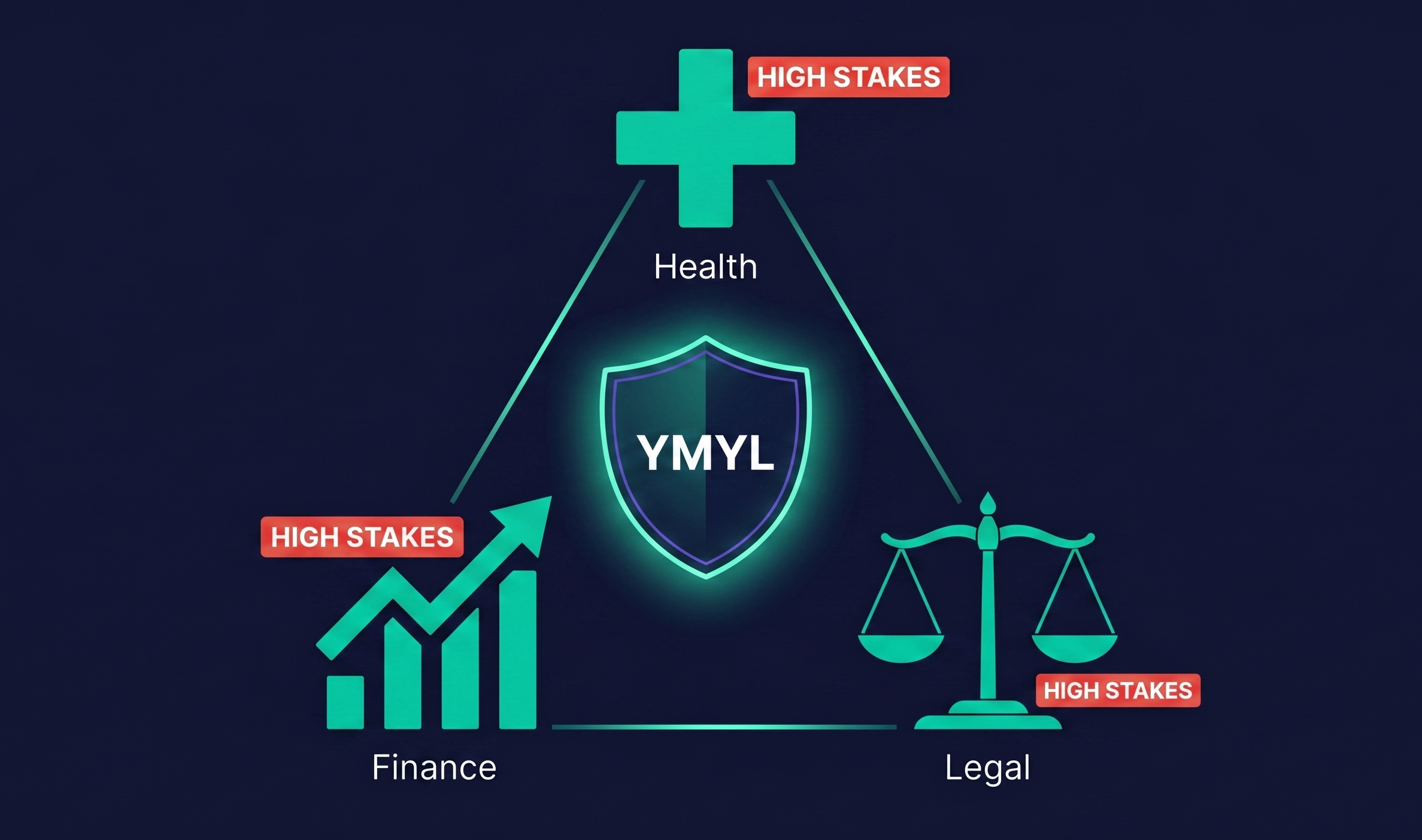
Not all content is judged by the same standard. A poorly sourced article about the best hiking trails carries different consequences than a poorly sourced article about drug interactions or investment risk. Google recognised this distinction formally in its Search Quality Rater Guidelines, where it created a specific category for content with real-world consequences: YMYL — Your Money or Your Life.
If your site covers health, finance, or legal topics, your content is being evaluated by a materially higher E-E-A-T standard than general informational content. Understanding what that standard looks like in practice — not just in theory — is the difference between building a site Google trusts and one it consistently ranks below its quality threshold.
What YMYL Actually Means
Google introduced the YMYL concept in its Search Quality Rater Guidelines as a category of pages that "could potentially impact the future happiness, health, financial stability, or safety of users." The definition is deliberately broad, but the guidelines give specific examples:
- Health and medical: symptoms, diagnoses, treatments, medications, mental health, emergency guidance
- Financial: investments, taxes, retirement planning, insurance, loans, financial advice
- Legal: contracts, rights, immigration, family law, criminal matters
- News and current events: topics affecting civic life, government policy, major world events
- Safety: emergency preparedness, dangerous activities, product safety
The practical significance of the YMYL designation is that Google's quality raters are instructed to apply the highest E-E-A-T standards when evaluating pages in these categories. A health article that would receive a "Medium Quality" rating for a general blog might receive a "Low Quality" or even "Lowest Quality" rating on a medical site — because the stakes of misleading someone are so much higher.
Why the Bar Is Genuinely Higher — and Why That Is Reasonable
Google's August 2018 core update — commonly called the "Medic Update" in the SEO industry — disproportionately affected health and wellness sites. Sites that had ranked well for years on the strength of content volume and backlinks saw dramatic traffic drops, while medically authoritative sites with formal credentials and peer-reviewed references held or improved.
The pattern that emerged from post-update analyses was consistent: sites affected tended to have content written by generalist writers with no disclosed credentials, no named authors, and no connection to the medical or scientific establishment. Sites that recovered fastest were those that could demonstrate a chain of authority — named medical professionals, institutional affiliations, and citations to primary research.
This is not Google being unfair to smaller publishers. It reflects a genuine problem: low-quality health content causes real harm. Outdated drug interaction information, misleading financial guidance, or legally incorrect advice about tenant rights can have serious consequences for the people who act on it. The elevated E-E-A-T bar exists because the cost of Google getting it wrong is higher in these categories than anywhere else.
YMYL E-E-A-T: What Google's Quality Raters Actually Check
Google's Search Quality Rater Guidelines (the November 2023 version runs to 176 pages) dedicate specific sections to YMYL evaluation. The criteria raters are instructed to apply go well beyond standard E-E-A-T checks:
Medical and health content
For health content, quality raters are specifically trained to look for:
- Professional medical credentials for the author. An article about managing Type 2 diabetes should be written or reviewed by a physician, endocrinologist, or registered dietitian — not a health blogger, however well-researched. The credentials should be visible on the page, not buried in a boilerplate author bio.
- Alignment with current medical consensus. Content that contradicts established medical guidance without strong evidence — even if well-intentioned — is flagged as low quality. This includes naturopathic claims that conflict with mainstream medicine without acknowledging the evidence gap.
- Dated content with clear update history. Medical information changes. A 2019 article about COVID treatment options without an update notice is a quality risk regardless of how accurate it was when published. Raters are specifically trained to check publication dates for health content.
- Clear scope limitations. High-quality medical content clarifies who it applies to, what conditions it addresses, and when a reader should consult a professional directly — not just a boilerplate disclaimer at the bottom.
Financial content
Finance YMYL checks have some overlap with health but also distinct requirements:
- Regulatory disclosure. Financial advice content in most jurisdictions carries legal disclosure requirements (FCA in the UK, SEC/FINRA in the US, etc.). Quality raters look for appropriate disclaimers — not because Google is checking legal compliance, but because the absence of standard disclosures signals that the author is not a genuine financial professional.
- Specificity of credentials. "Financial expert" or "investment professional" are not sufficient. Quality raters expect to see specific, verifiable credentials: CFA, CFP, RIA registration, or equivalent. A linked LinkedIn profile showing an active career in finance adds significant authority signal.
- Balanced treatment of risk. Content that presents only the upside of an investment strategy without discussing risk, volatility, or historical drawdowns fails the expertise test. Genuine financial expertise includes being honest about what can go wrong.
Legal content
Legal content is unique because jurisdiction matters enormously — advice that is accurate for England and Wales may be actively wrong for Scotland, and completely inapplicable in the United States.
- Jurisdiction is explicitly stated. Every piece of legal content should specify which legal system it applies to, and ideally the date it was last reviewed. UK employment law, for example, changes regularly through case law and statute.
- Author qualification is specific. "Legal professional" is not enough. Qualified solicitor, barrister, licensed attorney, or equivalent — with a jurisdiction — is what quality raters look for. Bar association membership or SRA registration adds verifiable authority.
- Limitation of liability is clear. High-quality legal content clarifies that it is general information, not legal advice, and directs users to seek professional counsel for their specific situation. This is both a legal best practice and an E-E-A-T signal.
Practical Steps for YMYL Sites
If you have genuine credentials — make them visible
The most common YMYL E-E-A-T failure among legitimate professional publishers is under-disclosure. A clinic's website written by actual physicians but without bylines, credentials, or review dates is leaving enormous authority on the table. Add:
- Named author bylines with full credentials on every article
- A dedicated author/contributor bio page with verifiable professional background
- A medical/financial/legal review panel disclosure if content is reviewed by professionals who did not write it
- Publication date and last-reviewed date on every piece of content
If you are a general publisher covering YMYL topics
General interest sites that cover health, finance, or legal topics face the hardest YMYL challenge: they typically lack the institutional authority of a hospital website or law firm. The path forward is to either commission content exclusively from credentialed professionals, or to be honest about your scope — covering only aspects of these topics where a non-credentialed perspective adds genuine value (personal experience with a condition, for example) while directing readers to professional sources for clinical or legal decisions.
Attempting to compete with WebMD or Citizens Advice on their core YMYL territory without equivalent credentials is a losing strategy — not because of SEO specifically, but because the content genuinely cannot be as trustworthy.
If you use AI assistance for YMYL content
AI-generated YMYL content carries additional risk beyond the standard E-E-A-T concerns covered in our AI content E-E-A-T guide. AI models can generate confident, well-formatted medical or financial content that is factually incorrect in ways that are not immediately obvious — including outdated drug dosages, superseded treatment guidelines, or jurisdiction-specific legal details the model was not trained on.
For YMYL topics, AI should be limited to structural and editorial assistance — organising information, improving clarity, checking readability. The substantive claims in health, finance, and legal content must be verified and attested to by a credentialed human professional, and that professional's name should be on the content.
How to Diagnose Your YMYL E-E-A-T Gap
The fastest way to identify where your YMYL content falls short is to look at it the way a quality rater would. For each piece of health, finance, or legal content on your site, ask:
- Can I verify the author's credentials from this page alone, without leaving the site?
- Is the publication and review date visible?
- Does the content cite primary sources (clinical guidelines, official financial regulators, statute) rather than just other websites?
- Does the content acknowledge its limitations and direct users to professionals for specific decisions?
- Would a qualified professional in this field be comfortable putting their name on every claim made?
If the answer to any of these is no, that is your E-E-A-T gap. You can also run the content through Credify's E-E-A-T Checker — YMYL content should be targeting scores of 70 or above before publishing, given the higher standard Google's systems apply.
The Honest Reality for Smaller YMYL Publishers
Building genuine YMYL authority takes time and cannot be faked through technical SEO. A health blog written by non-medical writers with a disclaimer at the bottom is not equivalent to a medically-reviewed site, regardless of how well-optimised the meta tags are.
The most effective long-term strategy for smaller YMYL publishers is to narrow scope ruthlessly — find the specific aspect of a YMYL topic where you have genuine, demonstrable expertise, and own that niche deeply rather than competing across a broad topic. A registered dietitian covering evidence-based nutrition for endurance athletes has a clearer, more defensible E-E-A-T position than a general wellness blog covering "healthy eating" with the same credentials.
"The key question to ask is whether the content creator has the necessary knowledge, skill, or experience for the topic." — Google Search Quality Rater Guidelines, 2023
In YMYL categories, Google has raised the bar on what "necessary knowledge" means. Meeting that bar requires real credentials, visible attribution, current sourcing, and honest scope limitations — not just well-written prose.
Related reading: The E-E-A-T Pre-Publish Checklist: 26 Signals to Check · What Is E-E-A-T? Google's Content Quality Framework Explained