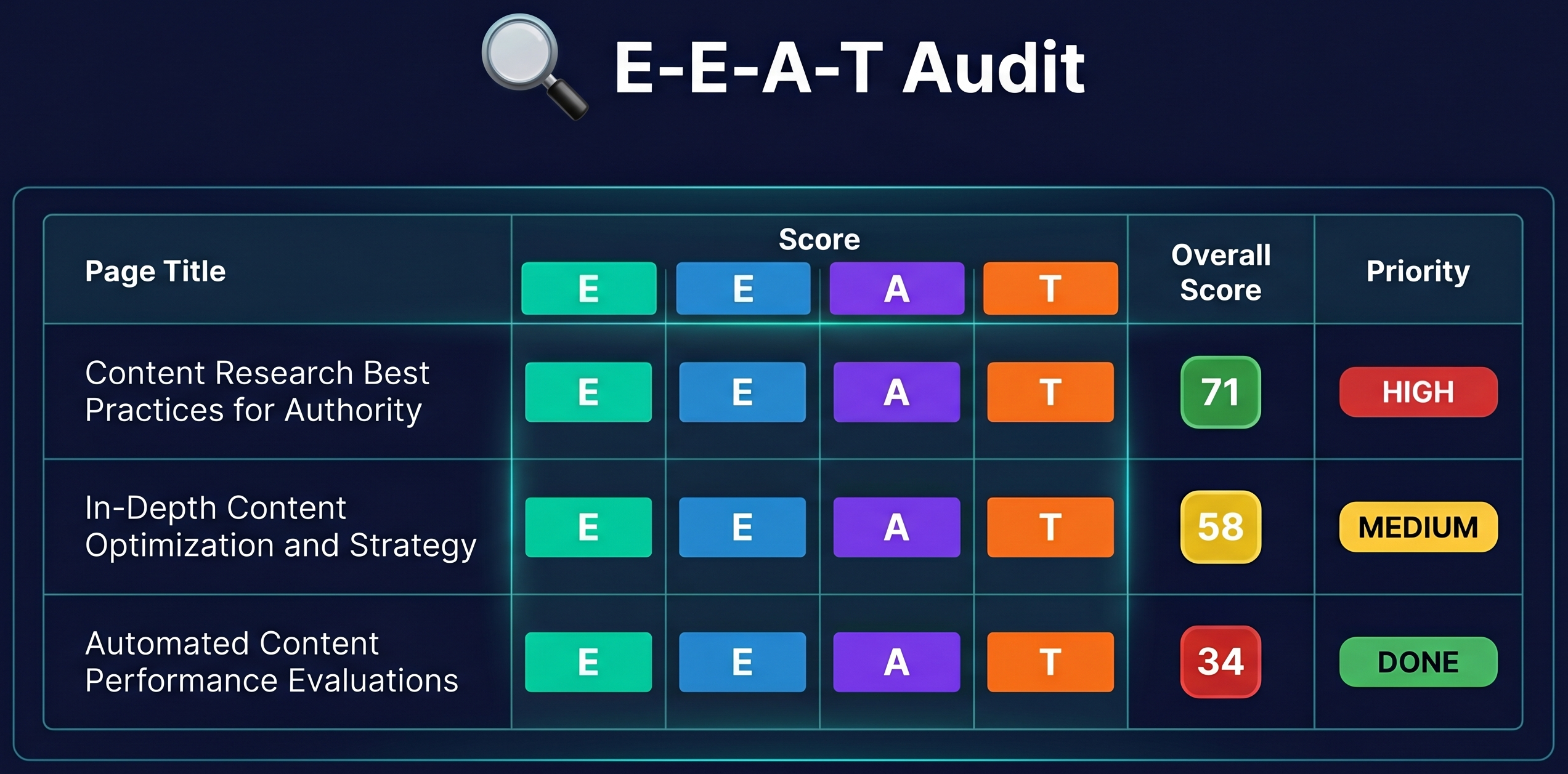
Most websites do not have one E-E-A-T problem — they have several, distributed unevenly across hundreds of pages. Some pages score well on Expertise but have no author attribution. Others have strong Trust signals but thin first-hand Experience. A few may be actively damaging the site's overall credibility by making unsupported claims or carrying outdated information that contradicts current understanding.
Running an E-E-A-T audit means doing three things in order: identifying which pages carry the most ranking risk, diagnosing exactly which dimension is failing on each, and prioritising improvements by impact rather than effort. Done systematically, this process converts a vague instruction to "improve E-E-A-T" into a specific, prioritised list of editorial actions.
This guide covers the full process from initial page selection through to a working improvement backlog. It assumes you are auditing an existing site — not building from scratch — and that not every page can be improved at once.
Step 1: Build Your Page Inventory
Before you can audit E-E-A-T, you need a complete list of the pages you are responsible for. For most sites, this comes from one of three sources:
- Your sitemap.xml — a clean, current sitemap gives you every URL the site considers indexable. Export it and use it as your starting inventory.
- Google Search Console — the Performance report shows every URL that has received at least one impression in the past 16 months. This catches pages that are indexed but missing from the sitemap, and gives you organic traffic data alongside the URL list.
- A crawl tool — for larger sites, a crawl gives you the full picture including pages that are neither in the sitemap nor receiving traffic. Screaming Frog's free tier covers up to 500 URLs and exports a complete crawl report.
Export your inventory to a spreadsheet. At minimum, each row should have: URL, page title, primary topic, current organic traffic (from Search Console), and a column for each of the four E-E-A-T dimensions. You will fill those columns in Step 3.
Step 2: Prioritise Which Pages to Audit First
Auditing every page at once is neither practical nor necessary. The pages that carry the most E-E-A-T risk are those where Google is already applying scrutiny — and where improvement will have the most measurable impact. Prioritise in this order:
Pages that have lost rankings in the past 6 months
In Google Search Console, filter the Performance report by date comparison: current 3 months versus the same period one year ago. Pages with declining impressions or average position are your highest-priority audit targets. Ranking drops after core updates, in particular, are strongly correlated with E-E-A-T weaknesses — the update did not break these pages, it revealed a quality gap that was always there.
YMYL pages regardless of performance
Any page covering health, finance, legal, or safety topics faces a higher E-E-A-T standard, as covered in the YMYL guide. Audit these pages even if they are currently ranking well — the risk of a future core update affecting them is higher than for general informational content, and the cost of under-preparation is significant.
High-traffic pages with thin authorship
Sort your inventory by organic traffic, descending. Any page in your top 20 by traffic that lacks a named author with verifiable credentials is a Trust risk disproportionate to its value. These pages are working despite a weakness — fixing the weakness protects the traffic you already have.
Pages with significant backlink equity
Pages that have earned external links over time carry Authoritativeness signals that take years to rebuild if the page loses rankings. A page with 40 referring domains that scores poorly on Experience or Trustworthiness is worth prioritising — the authority investment has already been made, and the E-E-A-T gap is the remaining obstacle to better performance.
Step 3: Score Each Page Across All Four Dimensions
For each priority page, you need a consistent scoring approach that maps to the same criteria Google's quality raters use. The four dimensions require different evaluation lenses:
Scoring Experience
Read the page as a sceptical user and ask: is there anything here that could only have been written by someone with direct, first-hand involvement in this subject? Specific markers of genuine experience include:
- Named outcomes with real numbers — not "significant improvement" but "34% reduction over 90 days"
- Edge cases and failure scenarios — things that only surface in direct practice, not in research summaries
- Specific dates, products, contexts — details that locate the experience in real time and place
- First-person voice used to describe actual involvement — not performed first-person for style
Score Experience on a simple 1–5 scale: 1 = entirely generic, no direct experience evident; 5 = page clearly written by someone with substantial direct experience, with multiple specific, verifiable details. Most AI-assisted or research-based content without human editing will score 1–2 on this dimension.
Scoring Expertise
Expertise is about the depth and accuracy of the content's technical claims. Ask:
- Are mechanisms explained, or just conclusions stated?
- Is terminology used correctly and consistently?
- Does the content acknowledge complexity, nuance, and exceptions where they exist?
- Would a qualified professional in this field find the content accurate and sufficiently detailed?
A common Expertise failure is content that is accurate at a summary level but lacks the depth that demonstrates genuine knowledge. "Dollar-cost averaging reduces the impact of market volatility" is accurate. Explaining why — that it lowers the average cost per unit over time because you buy more units when prices are low — demonstrates Expertise. The former is something anyone can write after reading one article. The latter requires understanding the mechanism.
Scoring Authoritativeness
Authoritativeness has both page-level and site-level components. At the page level, check:
- Is every significant claim supported by a named, verifiable source?
- Are expert voices present — named individuals with specific, relevant credentials?
- Do outbound links go to primary sources or institutional authorities?
- Is the author's authority on this specific topic established on the page?
At the site level — which affects every page — consider whether the domain has any external recognition in its subject area: citations from credible sites, press coverage, expert contributors with independent reputations. This cannot be changed page-by-page, but it contextualises how much page-level authority work you need to do. A low-authority domain needs stronger page-level signals to compensate.
Scoring Trustworthiness
Trust is the most structural of the four dimensions — it depends heavily on elements that exist across the site rather than within individual pages. For each page, check:
- Named author with verifiable credentials — visible on this page
- Publication date and last-reviewed date — both accurate and current
- All factual claims either cited or clearly attributable
- No misleading framing, selective evidence, or undisclosed conflicts of interest
- Site-level trust infrastructure present: Privacy Policy, contact information, consistent brand identity
A page can have perfect scores on the other three dimensions and still score low on Trust if it lacks a named author or carries inaccurate dates. Trust failures are often the quickest to fix — but they require editorial decisions, not just technical changes.
Step 4: Use a Tool for Consistent Scoring at Scale
Manual dimension scoring works well for small audits — 10 to 30 pages. For larger sites, scoring consistency degrades: the criteria you apply on page 50 tend to drift from the criteria you applied on page 5. Using a consistent scoring tool removes that drift.
Credify's E-E-A-T Checker scores content across all four dimensions using a consistent rubric applied the same way to every piece of content. For an audit workflow, the most efficient approach is to use the URL analysis feature — paste each priority URL into the checker and record the four dimension scores in your spreadsheet. This gives you comparable, consistent scores across your entire priority list in a fraction of the time manual scoring would take.
Record the raw dimension scores (0–100 per dimension) alongside your own qualitative notes. The tool identifies specific issues within each dimension — these become your improvement actions in Step 5.
Step 5: Build Your Improvement Backlog
Once every priority page has a score across all four dimensions, group your findings into three tiers:
Critical — fix before the next core update
Pages that score below 40 on Trustworthiness, or below 35 on any dimension while ranking for a competitive term. These are actively at risk. The actions here are typically structural: add a named author, fix dates, add citations to uncited claims, remove or rewrite misleading content.
These fixes are usually fast — most can be done in under an hour per page — but they require someone with editorial authority to make the calls, not just a content writer to implement changes.
High priority — improve within 30 days
Pages scoring 40–60 on one or more dimensions, particularly Experience and Expertise. These pages are not in immediate danger but are underperforming their potential. The actions here are editorial: add first-hand experience language, deepen technical explanations, add expert quotes, strengthen citations.
For Experience improvements specifically, this often means going back to the original subject-matter expert who provided the underlying knowledge and asking for specific details — outcomes, failure cases, unexpected findings — that did not make it into the first draft.
Monitor — no immediate action required
Pages scoring above 65 across all four dimensions. These pages are not a priority for improvement. Add them to a review cycle — check them every 6 months to ensure dates remain current, citations still resolve, and the content has not been superseded by developments in the field.
Step 6: Implement and Verify
Work through your Critical and High Priority pages systematically. For each page:
- Make the editorial changes identified in the audit
- Update the
dateModifiedin the page schema and the visible "last reviewed" date on the page - Re-run the page through the E-E-A-T Checker to confirm the dimension scores have improved
- Request re-indexing via Google Search Console using the URL Inspection tool
Set a realistic expectation for results. E-E-A-T improvements do not produce ranking changes overnight — Google's systems need to recrawl and reassess the page, and core update effects typically resolve gradually over weeks rather than days. A reasonable measurement window is 6–8 weeks after re-indexing before drawing conclusions about ranking impact.
Maintaining the Audit: Making It Ongoing
A one-time E-E-A-T audit ages quickly. Content published today will have outdated dates within a year. New expert sources will emerge that make current citations less authoritative. Fields evolve, and pages that accurately reflected current knowledge when written may become misleading as understanding changes.
The most practical approach is to build a lightweight maintenance cycle into your editorial calendar:
- Monthly: Re-audit any page that has declined in rankings since the previous month. Address issues immediately rather than accumulating a backlog.
- Quarterly: Review all YMYL pages and high-traffic pages for date currency and citation accuracy. Update where necessary.
- After each Google core update: Run the full prioritisation process again. Core updates frequently surface new pages with E-E-A-T gaps — or improve pages that were previously treated unfairly. Use post-update performance data as your new prioritisation input.
The sites that maintain strong E-E-A-T over time are not those that ran one audit in a specific month — they are those that built the audit habit into how they manage content. An E-E-A-T audit is not a project with a completion date. It is an ongoing editorial discipline.
"Think about the people who will read your page. Would they come away feeling that they've learned enough about a topic to help achieve their goal? Will they leave feeling like they had a good experience?" — Google Search Quality Rater Guidelines, 2023
That question is the simplest possible summary of what an E-E-A-T audit is trying to answer — page by page, dimension by dimension, across your entire site.
Related reading: The E-E-A-T Pre-Publish Checklist: 26 Signals to Check · How to Improve Your E-E-A-T Score: Step-by-Step Guide